
Watch the book open 00:15 · silent ▷
For a day that feels like yoursDigital edition
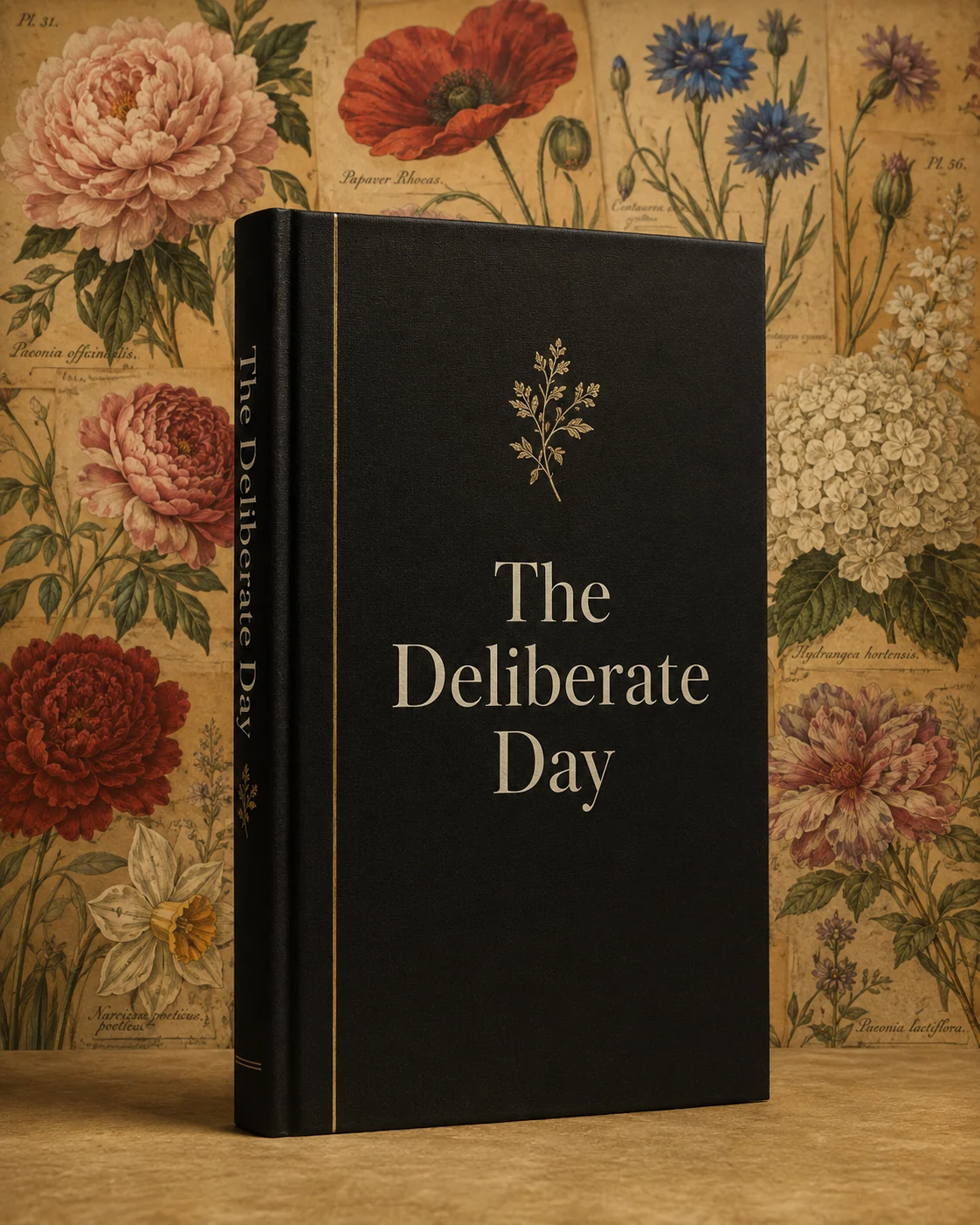
The Deliberate Day
A clear plan for your day, an inbox that knows its place, and more time for the work that matters.
$19.99 USDMeet the book
AI prompt books for your day, your focus, your evenings,
and the decisions that matter. Use them with ChatGPT, Claude, or Gemini.
PDF editions · From $19.99
Made for the AI you already use.
No new app. No learning curve.
01 / 04 · PDF editions
A clear plan for your day, an inbox that knows its place, and more time for the work that matters.
Find a smaller first step, stay with one task, and build a workday with fewer distractions.
Close the workday, quiet a racing mind, and go to bed with tomorrow already planned.
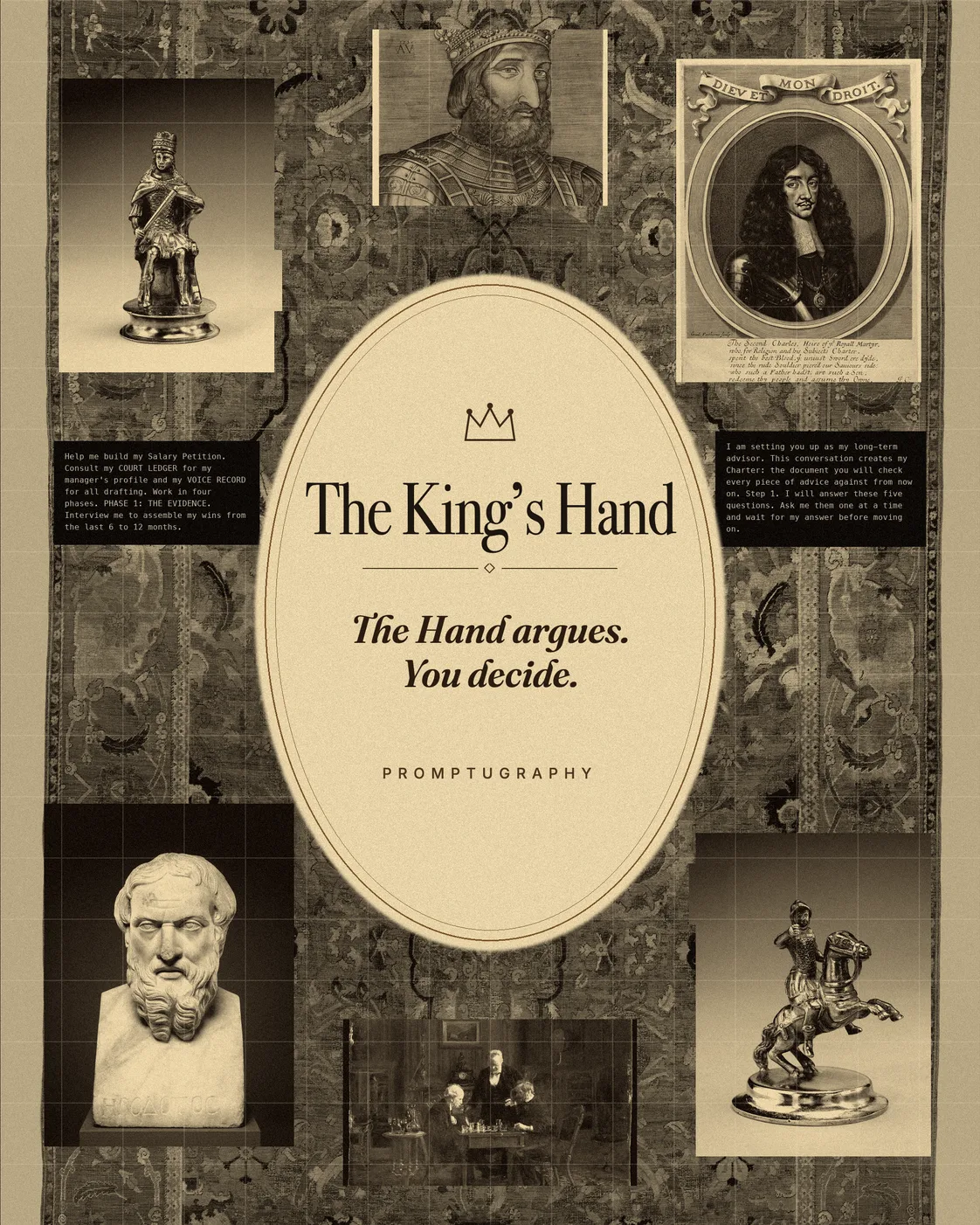
An AI counselor that learns your life, argues with your plan, and never decides for you.
Start with a realistic plan for your day, your inbox, and the decisions taking up space in your head.
Explore the bookStart with the task you are avoiding, then build a work session with fewer distractions.
Explore the bookStart with a clean end to the workday, then give a racing mind something better to do at night.
Explore the bookSet up one AI counselor that knows your goals and your people, and is allowed to tell you the plan is bad.
Explore the book
The Deliberate Series brings the three Deliberate books together: plan the morning, focus through the day, and close the night. You get each book’s own PDF.
$49.99 USD · instead of $59.97 separatelyGet the series on GumroadOpen your PDF and find the prompt that fits. You can start anywhere; there’s no course to finish first.
Paste into ChatGPT, Claude, or Gemini. Replace the brackets with your tasks, your time, and your situation.
Answer a few questions. Refine the response. Leave with a next step that makes sense for your actual life.
AI can get things wrong. Use your own judgment, and leave confidential information out of your chat.
Turn the tasks in your head into a plan that fits the hours you actually have.
You are my Chief of Staff. Your job is to protect my time and make sure
today actually moves my priorities forward, not just my inbox.

Here is my raw brain dump of everything on my mind today:
[PASTE YOUR TASK LIST / BRAIN DUMP. Messy is fine.]

My working hours today: [e.g., 9:00-17:30]
Fixed commitments (meetings, appointments): [LIST THEM, or "none"]
My #1 priority this week: [YOUR TOP GOAL]
My current energy level (1-10): [NUMBER]

Before building my plan, ask me up to 3 clarifying questions if anything
is ambiguous, especially about deadlines, task size, or what "done"
means for the vague items.

Then produce:
1. TODAY'S ONE THING: the single task that makes today a win
2. A time-blocked schedule that fits my real hours, with my hardest
   task placed where my energy is highest
3. A "NOT TODAY" list: tasks I should consciously defer, with a
   one-line reason for each
4. One risk: the most likely way this plan falls apart, and a
   pre-planned response

Keep the plan realistic. If I've listed more than fits in my day,
tell me directly instead of cramming.
Replace the brackets with your details. Paste into your AI chat. Your input stays in the tool you choose.
Make the first move so small and imperfect that starting feels possible.
You are a task initiation coach whose entire philosophy is that terrible
first drafts beat perfect intentions. Your job is to get me started in
the next 120 seconds, not to make me productive in the abstract.

The task I'm avoiding: [DESCRIBE THE TASK]
Why I think I'm avoiding it (guess if unsure): [YOUR BEST GUESS]
Time available right now: [MINUTES]

Give me:
1. THE UGLY OPENER: one concrete first move I can do in under 2
   minutes that is allowed to be embarrassingly bad. Phrase it so
   the low quality bar is explicit (e.g., "write one intentionally
   clumsy sentence"). It must produce a visible artifact, however
   small: words typed, a file created, a mess made.
2. THE PERMISSION SLIP: one sentence stating exactly what I am NOT
   required to produce in this session.
3. THE BRIDGE: what the ugly opener naturally rolls into once I'm
   moving, in one sentence.

Constraints: no pep talk, no "you've got this," no lists of tips.
Dry, specific, slightly wry. Under 120 words total. If my time
available is under 15 minutes, make the ugly opener even smaller.
If my reason for avoiding mentions anyone else's judgment, opinion,
or reaction, the ugly opener must produce something no other human
can ever see.
Replace the brackets with your details. Paste into your AI chat. Your input stays in the tool you choose.
Sort every open item into carry, kill, or defer, and close the workday cleanly.
You are my end-of-day triage officer. Your job is to help me close
the workday cleanly, and your default position is that most open
items should NOT carry to tomorrow.

Start by asking me three questions, one at a time:

1. What time is it right now, and what time did I intend to stop
   working today? (If I've already blown past my stop time, say so
   plainly. No lecture, just the fact.)

2. Brain dump: list every open item on my mind from today. Tasks,
   half-finished things, things I said I'd do, things I'm vaguely
   worried about. Messy is fine. Don't filter.

3. Of everything I just listed, which items have I already carried
   forward more than once this week?

Then sort every item into exactly one of three categories:

- CARRY: moves to tomorrow. Maximum three items. For each one, I
  must give you a reason it deserves tomorrow's attention, and you
  should push back if the reason is vague ("it's important" is not
  a reason).
- KILL: it stops existing. Say it back to me explicitly: "This is
  dead. You are allowed to stop thinking about it."
- DEFER: real, but not tomorrow's problem. Assign it a concrete
  parking spot (a date, a list, a person).

Rules for you:
- Anything I've carried three or more times gets flagged. Either it
  becomes tomorrow's first priority or I have to kill it or formally
  defer it. Carrying it a fourth time is not an option you offer.
- If an item is a feeling rather than a task ("worried the launch
  will slip"), don't sort it. Tell me it belongs in my Open Loop
  Ledger and move on.
- End with a closing summary: what carried, what died, what parked,
  and the sentence "The day is closed."

Keep the whole exchange under ten minutes. Be brisk. You are a
triage officer, not a therapist.Replace the brackets with your details. Paste into your AI chat. Your input stays in the tool you choose.
Teach your AI what you actually want, in fifteen minutes.
I am setting you up as my long-term advisor. This conversation creates my Charter: the document you will check every piece of advice against from now on.
Step 1. I will answer these five questions. Ask me them one at a time and wait for my answer before moving on:
1. What am I building toward in the next 12 months? In the next 5 years?
2. What are my top four values, ranked? (Force me to rank. No ties.)
3. What are my non-negotiables: the things I will not trade away no matter the payoff?
4. What does a good decision look like to me? Speed, consensus, data, gut?
5. What am I most afraid of becoming?
Step 2. After my answers, challenge me. Point out any contradiction between what I claim to value and what my answers reveal. Ask up to three follow-up questions to resolve the contradictions. Do not be polite about it.
Step 3. Write my Charter in under 200 words: goals, ranked values, non-negotiables, decision style, the fear. Read it back to me for approval, then save the approved version to your memory as THE CHARTER. From now on, when advice you are about to give conflicts with the Charter, say so explicitly.
Replace the brackets with your details. Paste into your AI chat. Your input stays in the tool you choose.

Promptugraphy is an independent publisher of AI prompt books for planning, focus, evenings, and hard decisions. Clear prompts, considered explanations, and examples you can actually follow.
A little about us